
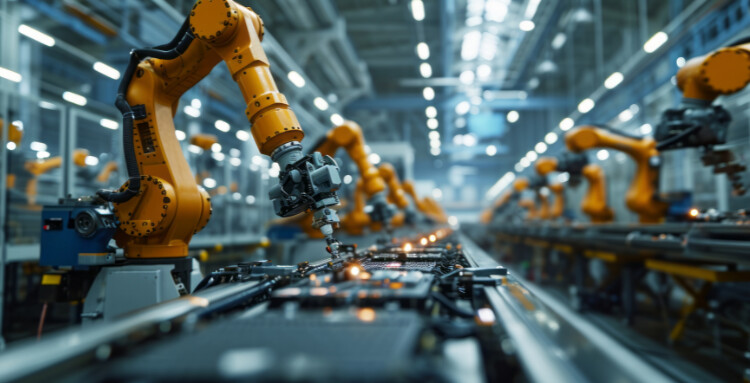
Artificial intelligence is starting to influence how industrial property risk is evolving in Australia—but not always in obvious ways.
It’s not just about automation or “smart buildings.” The bigger shift is happening behind the scenes. Decisions that were once based on experience or static data are now being shaped by systems that constantly learn, update, and adjust.
For a sector that has traditionally been quite stable, that’s a meaningful change. This shift in technology is changing the nature of industrial property risk, particularly across logistics and warehousing assets.
How AI Is Reshaping Industrial Property Risk
Location, access, and tenant demand still matter. That hasn’t changed.
What has changed is how those decisions are made.
As operations become more connected, industrial property risk is increasingly shaped by data systems rather than purely physical factors.
AI is now being used to assess things like freight movement, infrastructure pressure, and demand patterns all at once. That gives developers and investors a clearer picture—but it also means decisions are becoming more reliant on data models rather than human judgment alone.
In day-to-day operations, the shift is just as noticeable.
Systems can flag maintenance issues before they happen, adjust energy use automatically, and monitor performance across entire sites. It’s efficient. It saves time. In many cases, it reduces cost.
But it also means these assets are no longer purely physical. They rely on technology to function properly.
Adoption Is Growing—But Still Uneven
A lot of organisations are already using AI in some form.
What’s interesting is how differently it’s being used.
Some businesses have properly embedded it into their operations. Others are still trialling tools or applying it in isolated areas. That creates a bit of inconsistency across the sector.
You end up with situations where:
- Systems don’t fully integrate
- Data isn’t always clean or reliable
- Processes haven’t caught up with the technology
That gap—between using AI and actually managing it well—is where things can start to go wrong.
Where Risk Starts to Shift
As soon as technology becomes part of how an asset operates, the risk profile changes.
Not dramatically all at once—but enough that it needs attention.
Cyber risk is now part of property risk
As industrial sites become more connected, guidance from the Australian Cyber Security Centre highlights the importance of securing networked systems and infrastructure as part of broader operational risk management.
If something goes wrong on that side, it’s not just an IT issue. It can interrupt operations or affect tenants directly.
That’s a different kind of exposure than what many property owners are used to. Cyber exposure is now a core component of industrial property risk in Australia, particularly for connected industrial sites.
Reliance on systems introduces new pressure points
Automation improves efficiency, but it also creates dependency.
If a system fails or produces the wrong output, the impact can move quickly—especially in logistics-heavy environments where timing matters.
The question becomes less about whether systems are useful (they are), and more about how resilient they are when something doesn’t go to plan. This creates new layers of industrial property risk, where system failure can directly impact physical operations.
Data quality matters more than ever
AI doesn’t “fix” bad data—it amplifies it.
If the inputs are off, the outputs will be too. And when those outputs are being used to guide investment or operational decisions, the consequences can be significant. Poor data integrity can significantly increase industrial property risk, particularly where AI systems rely on inaccurate inputs.
Responsibility is less clear
One of the more subtle challenges is accountability.
When decisions are influenced by AI, it’s not always straightforward to determine where responsibility sits. That’s still being worked through across the industry.
Why Industrial Property Feels This More Than Most
Industrial property is already closely tied to supply chains, logistics, and infrastructure.
Add AI into that mix, and it becomes even more interconnected.
Warehouses are getting smarter. Distribution is becoming more automated. Site selection is more data-driven than it used to be.
All of that improves performance—but it also increases the impact when something breaks down.
What This Means in Practice
This isn’t about overhauling everything overnight.
But it does mean businesses need to start looking at risk a little differently.
Not just:
- Physical damage
- Liability
But also:
- System reliability
- Data integrity
- Cyber exposure
In many cases, those risks overlap.
Ultimately, industrial property risk is no longer just about buildings and location, but also systems, data, and connectivity.
A More Balanced View of AI
There’s a tendency to talk about AI in extremes—either as a major opportunity or a major threat.
In reality, it’s both.
It can make industrial assets more efficient, more responsive, and easier to manage. At the same time, it introduces new dependencies that didn’t exist before.
The key is understanding that both sides exist—and planning accordingly.
Final Thought
Industrial property isn’t just physical infrastructure anymore.
It’s becoming a mix of buildings, systems, and data—all working together.
As that continues, the definition of risk shifts with it. Not overnight, but steadily.
And the businesses that stay ahead of that shift will be in a much stronger position than those that treat it as purely a technology issue. Understanding how industrial property risk is changing is essential for managing exposure in a technology-driven environment. Get in contact with Barrack here to understand your industrial property risk today.